
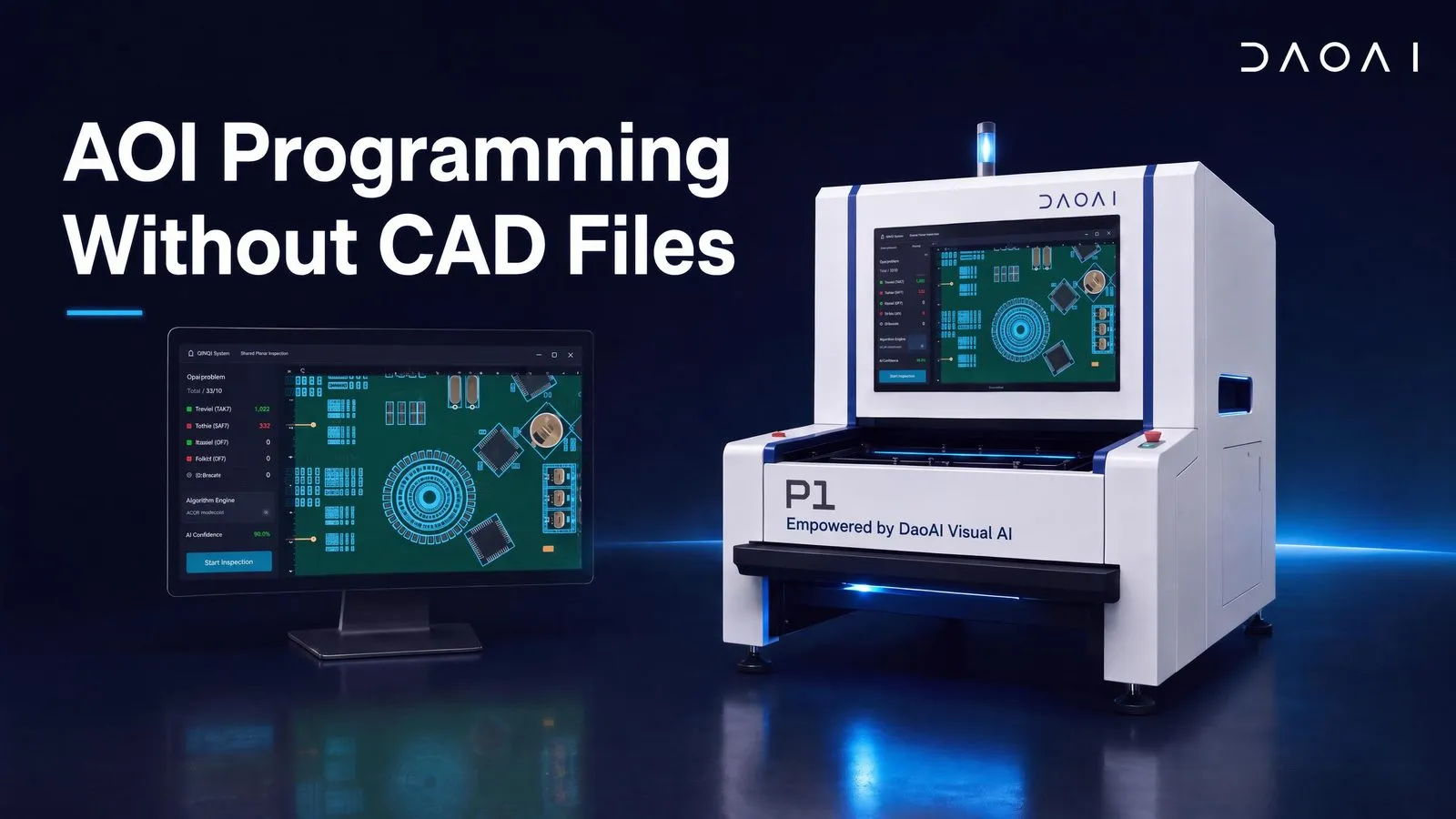
AOI Programming Without CAD Files: How It Actually Works
No CAD files, no component library — how golden-board AI programming actually works step by step, and how it compares to the traditional 3–5 hour AOI workflow.
July 21, 2026
A head-to-head comparison of AI-powered and traditional AOI systems — setup time, accuracy, flexibility, and total cost of ownership for PCBA manufacturers.
Is your SMT line truly running at full capacity? Or is the performance quietly being eroded by the endless cycle of AOI programming, threshold tweaking, and false call reviews?
If you have ever watched a skilled process engineer spend hours reprogramming an AOI system for a new board — only to spend the next shift chasing phantom defects — you already understand the cost. Traditional AOI was built for a different era of manufacturing. Today's high-mix, rapid-changeover environment demands something fundamentally different.
This page compares DaoAI's AI-powered AOI with traditional rule-based systems across the dimensions that matter most: setup time, programming overhead, false call rates, and total cost of operation.
| Dimension | Traditional AOI | DaoAI AI AOI |
|---|---|---|
| Core Technology | Rule-based pixel / template matching | Feature Cognitive AI — understands components conceptually, not just visually |
| NPI Setup Time | 2–8 hours per new board | Under 5 minutes (Auto-Match) |
| Programming Requirement | CAD dependency, manual threshold tuning, specialist engineer required | No-code. Operators capture and run — no libraries, no tweaking |
| False Call Rate | High — sensitive to lighting variation and minor component shift | Extremely low — AI distinguishes real defects from visual noise |
| New Component Learning | Manual template database entry per component | Operator-led retraining in minutes — no specialist required |
| Operator Skill Required | High — dedicated AOI specialist | Low — trained in hours, not weeks |
| Edge / Privacy | Varies by vendor — some require network connectivity for processing or updates | 100% edge processing — data never leaves your facility |
The NPI Paradox: Your Inspector Becomes Your Bottleneck
At the heart of traditional AOI is a fundamental architectural problem. These systems are built on template libraries — pre-built pixel maps of what a "good" board should look like. Every time a new product is introduced (NPI — New Product Introduction), an engineer must rebuild that library from scratch. In a high-mix, low-volume environment, this means programming becomes a permanent fixture of your operation — a recurring tax, not a one-time investment.
The Programming Tax: 30% of Your Capacity, Gone
Research consistently shows that SMT lines operating with traditional AOI lose 20–35% of their available production capacity to programming overhead and changeover delays. That is not downtime from machine failure — that is time you actively pay for while your line sits idle waiting for an AOI program to be ready.
False Call Fatigue: When the System Cries Wolf
Traditional AOI systems generate false positives from pixel-matching logic. Each alert requires human review. Over time, operators buried under hundreds of false calls per shift start to miss the real defects — not from carelessness, but because the system has destroyed their trust in the alerts.
Auto-Match Technology: From Hours to 5 Minutes
DaoAI's proprietary Auto-Match technology eliminates the NPI programming bottleneck at its source. The system captures a reference board, identifies component locations, and is ready to inspect — in under five minutes. No CAD files required. No threshold calibration. No specialist engineer standing at the machine for half a day.
Feature Cognitive Inspection: Beyond Pixels
Traditional AOI asks: "Does this pixel map match the reference?"
DaoAI asks: "Is there a correctly placed, correctly oriented resistor at this location, within acceptable quality parameters?"
DaoAI's AI understands the concept of an IC, a capacitor, a solder joint — not just an image of one. The result is an inspection system that generates actionable alerts, not noise.
Turn Your Operators into AI Architects
With traditional AOI, inspection programming is a specialist skill held by 1–2 people. DaoAI's no-code interface means any trained operator can set up a new job, review results, and retrain the model when needed. Your best engineers are free to work on what actually moves the needle — including exploring AI Agents in industrial inspection and where they fit on the SMT floor.
Consider a mid-size EMS facility running two SMT lines:
Weekly savings: ~$1,560 (traditional) vs ~$27 (DaoAI) = ~$1,533 recovered per week
Annual savings on programming labor alone: ~$79,700
(Excluding recovered machine uptime, rework cost reductions, and freed engineering hours.)
Wondering what that 5-minute setup actually looks like? We walk through the full golden-board programming process in AOI Programming Without CAD Files: How Golden Board Programming Works.
DaoAI doesn't ask you to abandon your quality processes — it asks you to stop accepting the inefficiency as inevitable.
Q1: What is the biggest advantage of DaoAI over traditional AOI?
The 5-Minute Setup via Auto-Match technology. Traditional AOI systems require hours of programming per new board type. DaoAI eliminates this bottleneck entirely, allowing operators — not specialist engineers — to get a new job running in minutes.
Q2: Does DaoAI require defect samples to train?
No. DaoAI uses Feature Cognitive AI to understand what a correctly assembled component should look like, built from non-defective reference images. You do not need to collect defect samples to begin inspection.
Q3: Can DaoAI handle high-mix production environments?
Yes. This is precisely where DaoAI delivers the most value. The system is designed for frequent product changeovers — operators can retrain for a new board type in minutes, making it ideal for EMS facilities and high-mix PCBA manufacturers.
Q4: Is DaoAI's inspection data stored in the cloud?
No. DaoAI processes all data at the edge. Video and inspection data never leaves your facility, ensuring full privacy compliance and zero latency dependency on external networks.
Q5: What happens when my product design changes slightly?
Operators can quickly retrain the model using new reference images. There is no need to rebuild the entire inspection library from scratch — targeted retraining on the changed areas is typically sufficient.
👉 today to discover how your SMT line can run with DaoAI AI AOI.
No CAD files, no component library — how golden-board AI programming actually works step by step, and how it compares to the traditional 3–5 hour AOI workflow.
July 21, 2026
What is the "Programming Tax" in SMT manufacturing? The Programming Tax is the significant efficiency loss—often ...
January 23, 2026
As a member of the Canadian Technology Accelerators program(CTA), DaoAI is honored to join with other outstanding ...
April 08, 2025
AI inspection insights, product news, and industry analysis. Once a month, no noise.