AOI programming without CAD files works by having the system learn a board directly from one physical "golden" sample instead of from engineering data. A camera captures the known-good board, AI automatically locates components and generates inspection regions, and operator feedback refines the model over time. This removes the CAD import, component-library build, and manual threshold tuning that make traditional AOI setup take anywhere from a few hours to, for complex boards, several days.
For high-mix EMS shops, the way an AOI machine gets programmed often matters more than how it inspects. A line that changes over several times a day lives or dies by setup time. This article explains, step by step, how CAD-free (golden-board) programming actually works, how it differs from the traditional workflow, and the questions engineers should ask before trusting it on the floor.
Why Does Traditional AOI Programming Take So Long?
Traditional AOI programming is slow because it rebuilds a board's inspection logic from engineering data every time. A skilled engineer imports CAD/Gerber and placement data, verifies or extends a component library, teaches fiducials, defines board regions, sets per-component checks against IPC-A-610 criteria, and then tunes thresholds to suppress false calls. Published programming guides describe this as a multi-hour job for a straightforward board, stretching to days for complex, dense assemblies.
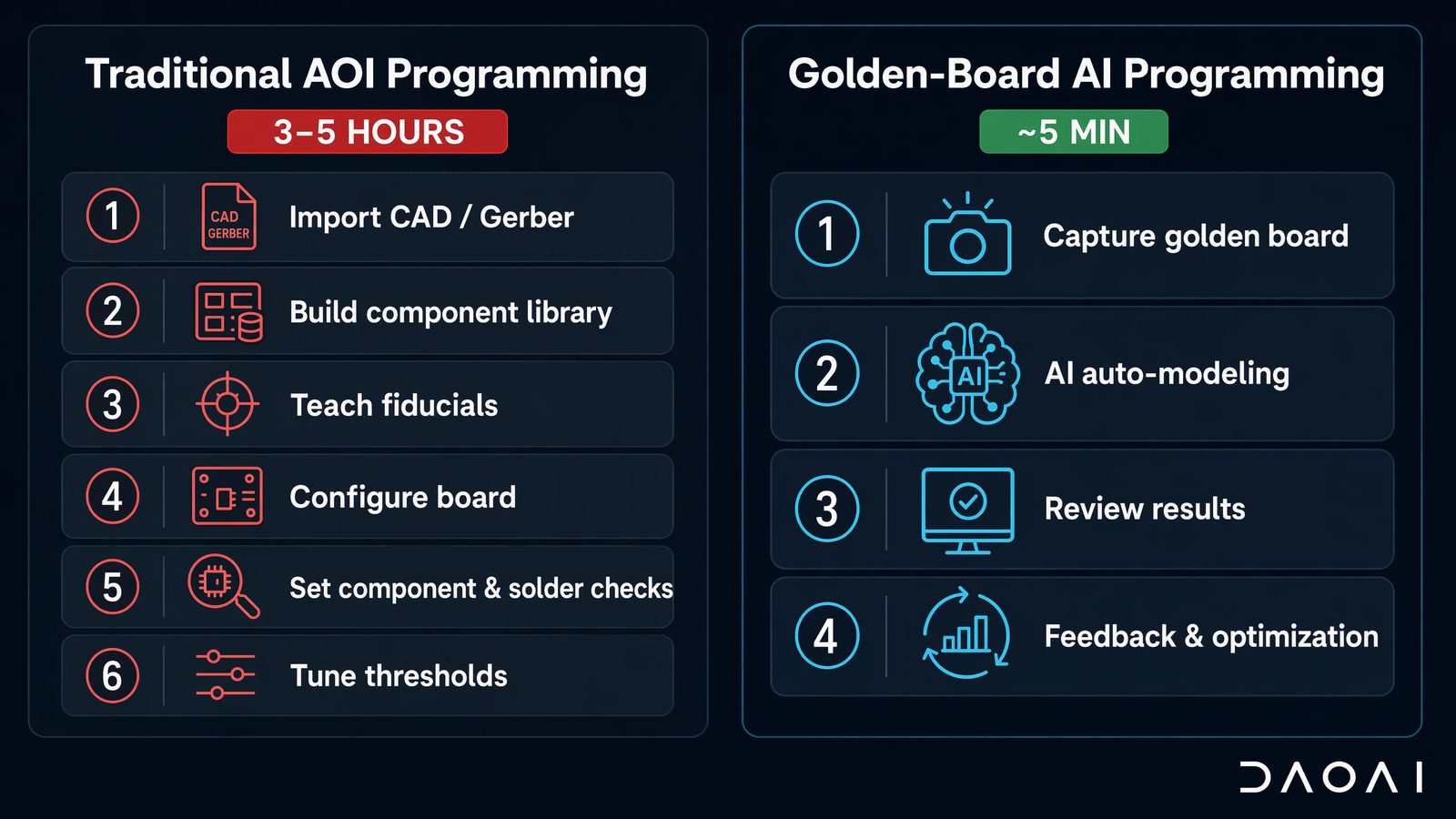
The traditional workflow generally runs in six stages:
- CAD / Gerber + placement-data import — load Gerber and component placement (centroid) data and match layers to the board stackup. A BOM is often added for part values and polarity, though the geometry comes from the placement data.
- Component library verification — confirm or create library entries, including custom parts.
- Fiducial teaching & alignment — scan a reference board and select fiducials so the software can align.
- Board configuration — define edges, cutouts, and no-inspect zones (e.g., heat sinks).
- Component & solder checks — set presence/absence, polarity, and placement-offset checks, typically mapped to IPC-A-610 (and, for solder-joint acceptability, J-STD-001) criteria.
- Threshold tuning — adjust limits for bridging, voids, and offsets, and classify defects as critical/major/minor.
Every stage assumes you have clean CAD data and time to tune. In high-mix, low-volume production — where CAD may be missing, incomplete, or from a customer who won't share it — stages 1 and 2 alone can stall a changeover.
Workflow steps drawn from published AOI programming guides (e.g., Aivon's step-by-step guide and Unisoft's programming overview), 2024–2025. Setup time varies widely with board complexity; treat any single figure as board-dependent.
What Is Golden-Board Programming?
Golden-board programming teaches the AOI system from a single physical known-good board — the "golden board" — instead of from CAD data. The system photographs this reference, and modern AI automatically detects components, extracts their visual features, and builds inspection regions by comparing production boards against the golden reference. The golden board is the specification, so no CAD file or pre-built component library is required to start.
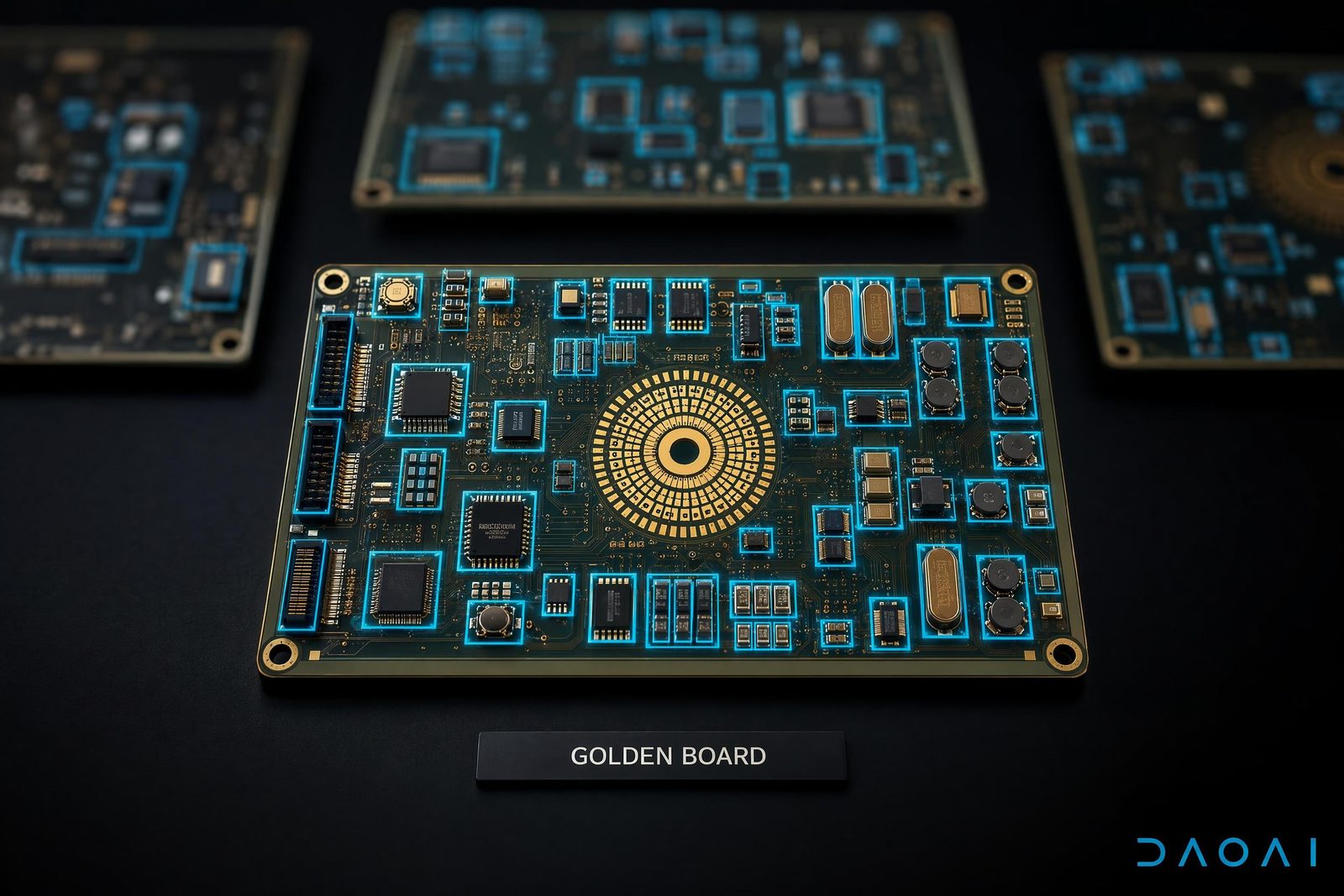
The "golden board" concept itself is not new — a known-good reference has long been part of AOI setup. (Most traditional AOI installed in the last decade actually builds its inspection model primarily from CAD/algorithmic data, using the reference board mainly for alignment and threshold optimization.) What changed with AI is what the software can do from that single board: older systems still needed CAD data and a component library on top of it, whereas newer AI systems can generate a usable program from the golden board alone.
How Does CAD-Free, AI-Based Programming Work Step by Step?
CAD-free AI programming replaces manual setup with automatic feature recognition. In practice it runs in four steps: scan one golden board; the AI auto-detects components and generates inspection frames; it sets initial thresholds from the reference image; and it learns from operator feedback on false calls, refining the model as production runs. Setup that took hours collapses to minutes because no CAD import, library build, or manual framing is involved.
- Capture the golden board. One known-good board is scanned. This single sample defines the acceptable appearance of every component and joint.
- Automatic feature recognition. Rather than matching pixel patterns to a CAD footprint, the AI recognizes what a component is — its body, leads, polarity marks, solder fillets — and auto-generates the inspection regions. DaoAI calls its approach Feature Cognitive Inspection.
- Initial thresholds from the reference. The system derives starting acceptance limits from the golden board instead of requiring an engineer to type them in.
- Feedback learning on the line. When an operator marks a flagged image as a false call, that judgment feeds back into the model. Each line's real-world experience becomes training data, so false-call rates trend down over repeated runs.
This is the same broad direction several vendors are moving in — Saki, Marantz, and Mycronic all offer forms of auto-programming. The practical differences are in what inputs are still required: many auto-programming tools still expect CAD data or a maintained component library, whereas a golden-board-only approach like DaoAI's is designed to run without either. If you're evaluating systems, that input requirement is the question to pin down.
Traditional vs CAD-Free AOI Programming
The core difference is the input: traditional AOI programming is driven by CAD/BOM data and a component library, while CAD-free programming is driven by a single golden board plus AI feature recognition. This changes setup time from hours to minutes and shifts who can run a changeover from a dedicated programming engineer to a line operator.
| Dimension | Traditional AOI programming | CAD-free (golden-board) AI programming |
|---|---|---|
| Primary input | CAD / Gerber + placement data + component library | One physical golden board |
| Typical setup time | 3–5 hours per board (DaoAI-cited; varies with board complexity in independent guides) | ~5 minutes, operator-run (DaoAI-reported) |
| Who runs it | Dedicated AOI/programming engineer | Line operator |
| CAD availability | Required | Not required |
| New/custom components | Manual library entry | Auto-recognized from the board |
| False-call handling | Manual threshold tuning | Feedback learning over time |
| Best fit | Stable high-volume lines | High-mix, frequent-changeover lines |
For a deeper head-to-head, see DaoAI vs. traditional AOI: which is right for your SMT line.
Is AOI Accurate Without CAD Data?
Yes — accuracy without CAD depends on the quality of the golden board and the AI's ability to recognize components, not on CAD data itself. CAD-driven programming leans on where parts should be and their specified values; a golden-board approach leans on what a good board actually looks like, which is what inspection ultimately compares against. Either way, acceptance criteria can be aligned to IPC-A-610, the industry standard for PCBA visual acceptability.
This matters for trust on the floor. IPC-A-610, "Acceptability of Electronic Assemblies" (current revision IPC-A-610J, released 2024), is the globally recognized benchmark for what counts as an acceptable solder joint, placement offset, or defect class. Its criteria can be translated into AOI rule sets regardless of whether the program was built from CAD or a golden board — so CAD-free programming does not mean abandoning a recognized quality standard. DaoAI states its P Series achieves ≥98% detection accuracy with up to 80% fewer false calls than traditional AOI; those are vendor-reported figures, not independently verified here, and any shop should validate them on its own boards during a demo.
What Results Does CAD-Free Programming Deliver in Practice?
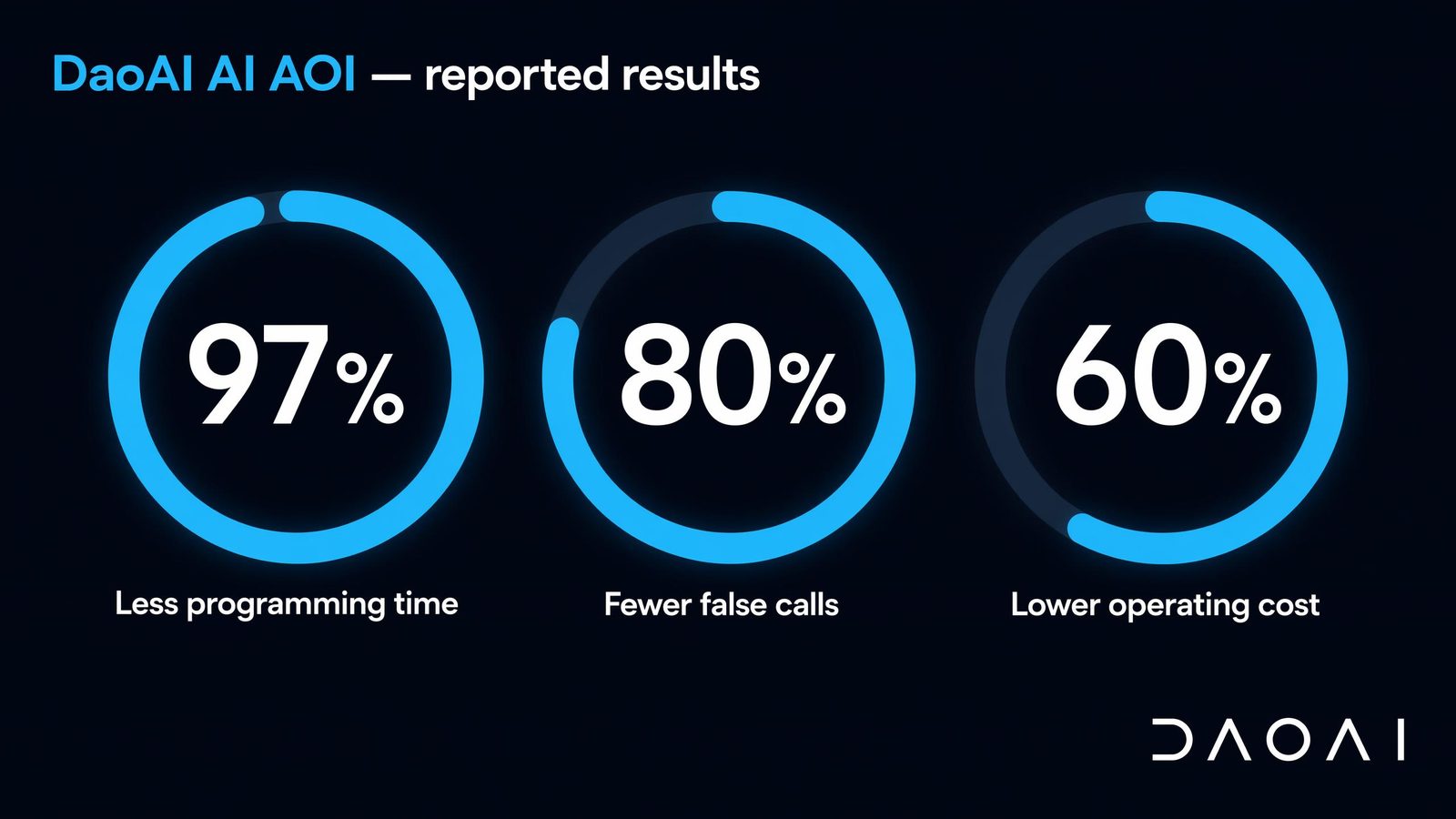
CAD-free programming mainly pays off in changeover time, labor, and false-call rework. DaoAI reports that moving from a traditional 3–5 hour setup to a ~5-minute, operator-run golden-board workflow cuts programming time by up to 97%, reduces false calls by up to 80%, and lowers overall operating cost by around 60% — because a line operator, inspection-ready in about 30 minutes, replaces a dedicated programming engineer.
| Metric | DaoAI-reported result |
|---|---|
| Programming-time reduction | up to ~97% (3–5 hours → ~5 minutes) |
| False-call reduction | up to 80%, improving over time via feedback learning |
| Overall operating-cost reduction | ~60% |
| Labor savings | ~USD 15,000–40,000 per person / year (re-inspection + line-stoppage) |
| Operator ramp-up | inspection-ready in ~30 minutes; no AOI programming engineer |
These are vendor-reported figures, drawn from DaoAI's production deployments — including with a major Asian electronics manufacturer — where board programming that previously took 3–5 hours is completed by a line operator in about 5 minutes. For the mechanics behind those numbers, see how AI cuts PCBA AOI programming from 3 hours to 5 minutes. Any shop should confirm the numbers on its own boards during a demo — which, because setup takes minutes, is realistic to do live.
Frequently Asked Questions
Do I need any CAD or BOM data at all for golden-board AOI programming?
No. A golden-board approach starts from one physical known-good board. CAD or BOM data can optionally improve labeling, but it is not required to generate a working inspection program.
How does the system handle a component it has never seen?
Feature-recognition AI identifies components by their physical characteristics rather than matching a stored footprint, so genuinely new or custom parts are detected from the golden board without a manual library entry.
Can a line operator really run a changeover without an engineer?
That is the intent of CAD-free programming. Because there is no CAD import or manual framing, setup is reduced to scanning a golden board and reviewing flagged images — tasks an operator can perform. DaoAI reports operators are inspection-ready in about 30 minutes of training.
Does CAD-free programming still meet IPC-A-610?
Yes. IPC-A-610 acceptance criteria define what an acceptable assembly looks like; they can be mapped into the inspection logic regardless of how the program was created.
How is this different from the AI auto-programming other AOI vendors offer?
Many auto-programming tools still require CAD data or a maintained component library. The key question when comparing systems is which inputs are truly optional. A golden-board-only workflow is designed to run without CAD or a pre-built library. You can review DaoAI's approach and full specs in the resource center.
See 5-Minute Programming on Your Own Board
DaoAI's P Series runs the golden-board workflow across offline (P1/P2) and inline (P3/P3D) configurations — the same CAD-free programming for high-mix benches and high-volume lines alike.
Book a Personalized Demo Explore the P Series AI AOI