AI Is Revolutionizing Crystal Inspection In the Chemical Industry
In the modern chemical industry, crystal inspection has a crucial impact on the quality and performance of products. ...
April 09, 2025
In the notebook assembly process, the complex structure of components, high precision assembly requirements, and ...
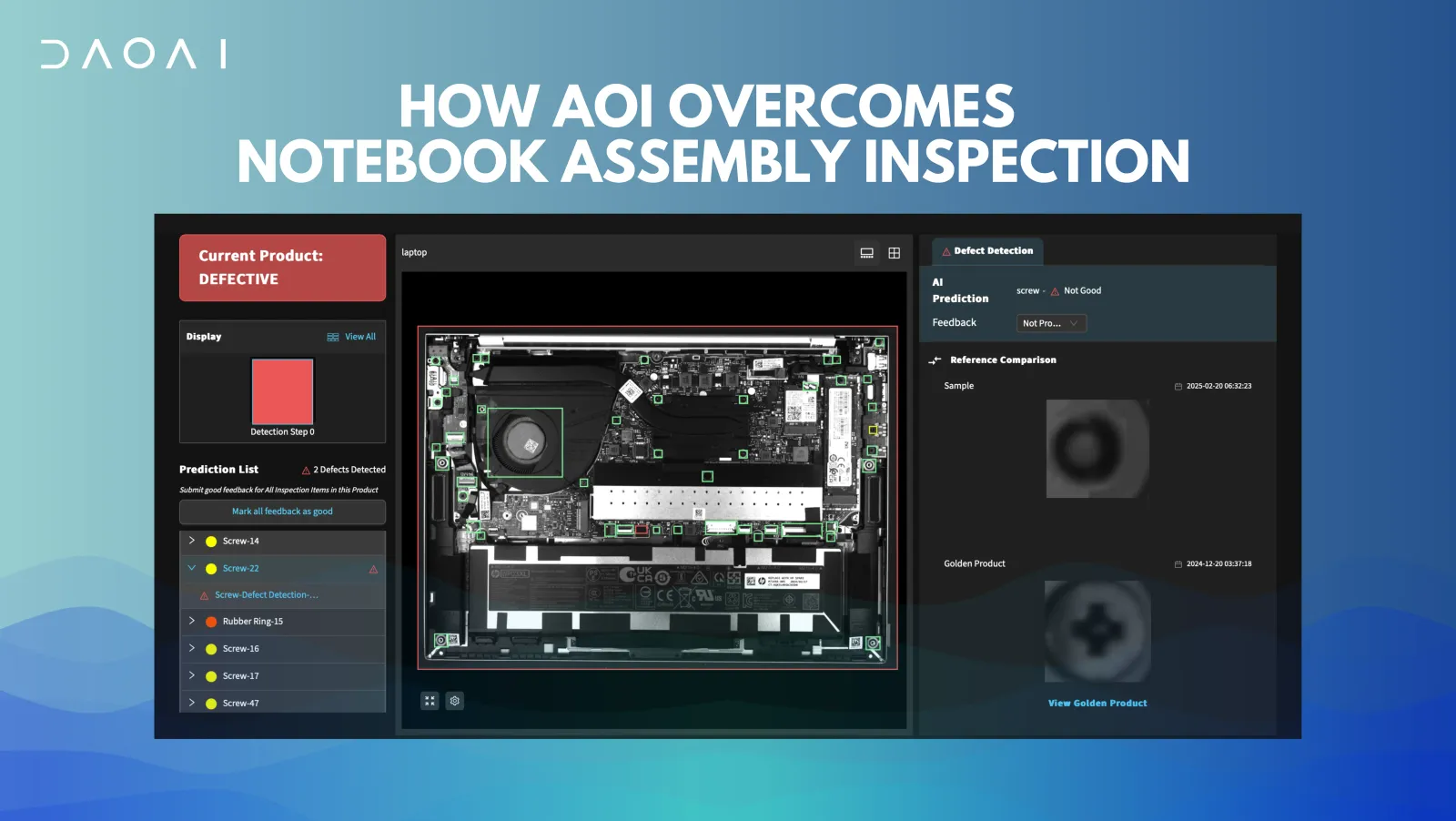
In the notebook assembly process, the complex structure of components, high precision assembly requirements, and rapidly changing production environment often render traditional inspection methods incapable of capturing every potential defect. This leads to missed detections, misjudgments, and high rework costs. AOI (Automated Optical Inspection) technology was designed specifically to address these pain points: with its high-speed, precise, pixel-level detection capabilities, it can instantly capture and analyze critical assembly details, enabling rapid defect identification and reducing hidden costs due to quality oversights. Not only does AOI enhance inspection efficiency, but through dynamic feedback and self-optimization mechanisms, it continuously improves model performance and ultimately delivering higher production efficiency and increased market competitiveness for enterprises.
Currently, notebook assembly inspection faces numerous challenges and pain points:
Component Diversity and Complexity
DaoAIAOI system features pixel-level detection capabilities, allowing it to precisely identify the assembly conditions of various components, including motherboard interfaces, screen adhesion, and keyboard layouts. This ensures that every component meets assembly standards. AOI can also blur the background artificially and allocate more computing power to frequently defective areas for focused inspection.
Multi-Component Detection: The AOI system can inspect multiple components simultaneously. Using annotation tools, different components can be marked to ensure accurate recognition of each part.
High-speed Production and Real-time Inspection Requirements
DaoAIAOI system has ultra-high-speed and precise detection capabilities, with each inspection area requiring only 10 milliseconds, achieving an initial accuracy rate of 99.7%. Its feedback loop mechanism optimizes the system in real-time based on inspection results, ensuring stability and reliability.
Real-Time Inspection: The AOI system conducts real-time inspections on the production line. Its high-speed and precise detection ensures that every product and defect is identified promptly, preventing defective products from proceeding to the next stage.
Changeable Production Environment
DaoAIAOI system can pre-establish multiple product models, allowing it to quickly adapt even when specific components undergo iterations or replacements. The system can efficiently train new models to suit high-frequency, rapid mold-switching production lines.
Rapid Model Switching: The AOI system quickly adapts to the design variations of different laptop models by adjusting model parameters and annotations, enabling rapid mold switching to meet diverse production line demands.
Defective Samples are Scarce and Difficult to Obtain
DaoAIAOI system employs unsupervised anomaly detection algorithms to identify potential unknown defects such as wear, scratches, and foreign object contamination. Its feedback loop mechanism continuously optimizes the detection model in real time, enhancing accuracy.
Usage Process
Through this tutorial, you will gain a comprehensive understanding of the complete process for using the DaoAI AOI system to perform laptop assembly inspection.
Step 1: Create a New Model
On the product management page, click “New Inspection Works”.
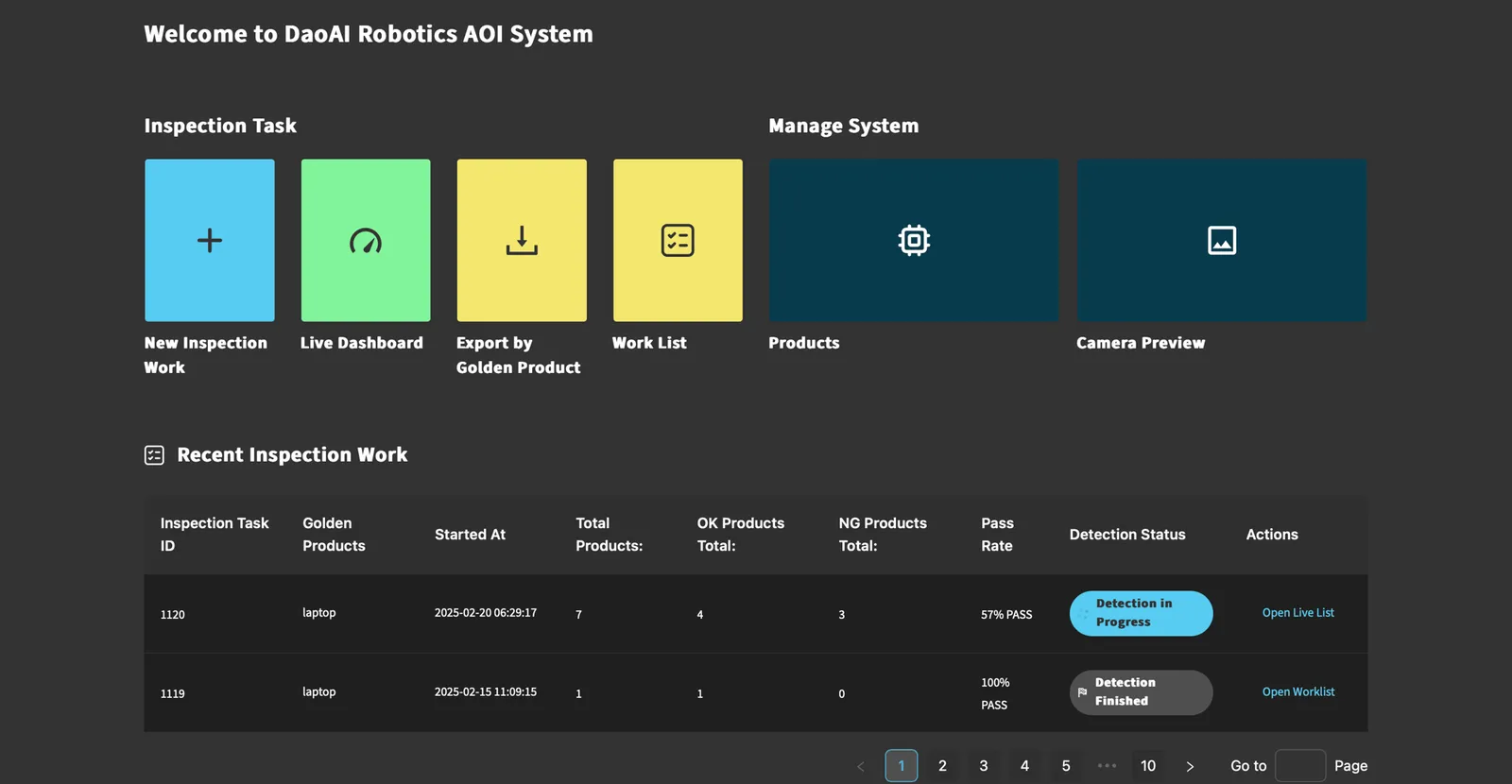
Step 2: Image Capture and Labeling
Use a high-precision camera to capture images of the laptop motherboard, ensuring that clear and complete images are collected. In the toolbar at the bottom right, click the labeling tool to accurately annotate each component in the image. For example, label the entire laptop as "product," and then label key components such as the motherboard, CPU, memory, hard drive, screws, and keyboard with corresponding tags. This process requires careful attention to detail to ensure that the model can correctly identify and detect each component.
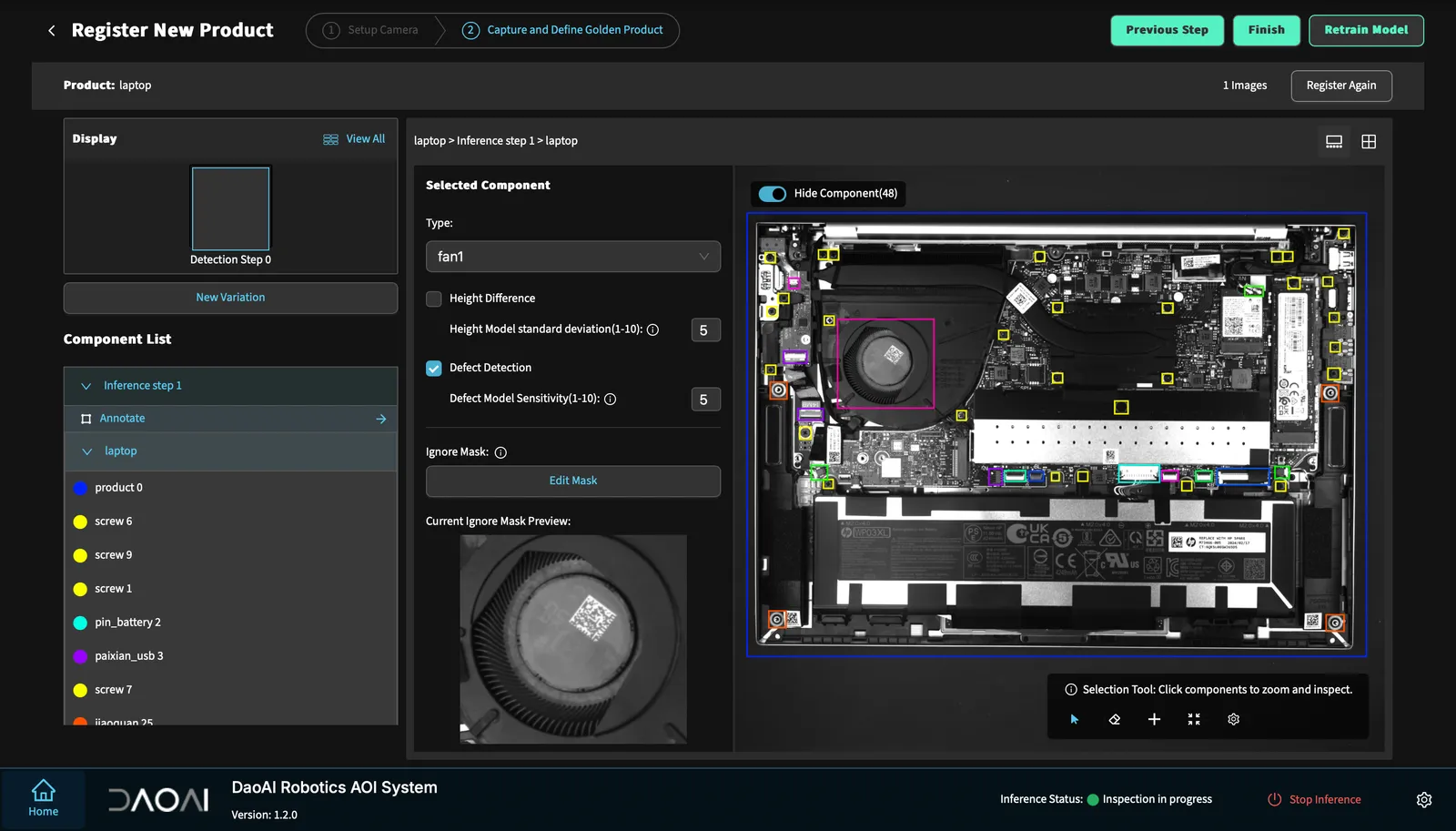
Step 3: Model Training
After completing the annotation, click the "Start Training" button, and the system will automatically begin training the model. During the training process, the system will learn the features and assembly requirements of each component based on the labeled data, continually optimizing the model parameters to improve detection accuracy. Return to the main page and wait for the model training to finish.
Step 4: Create a New Detection Task
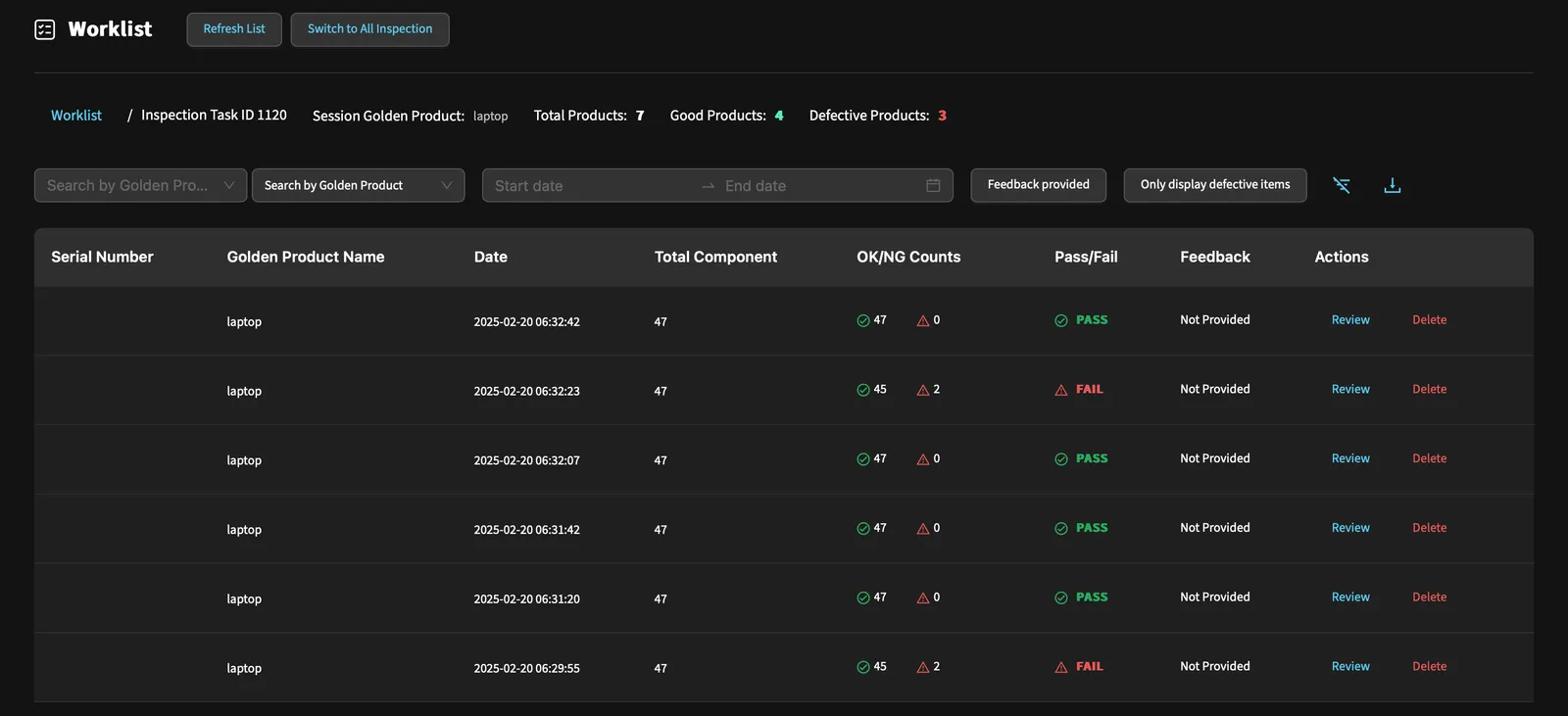
Once the model has been trained, create a new detection task using the trained model. Place the notebook to be inspected on the detection platform, and the system will automatically use the model to perform the inspection. Any assembly anomalies (such as missing, misaligned, or damaged components) will be accurately detected and clearly displayed in the results.
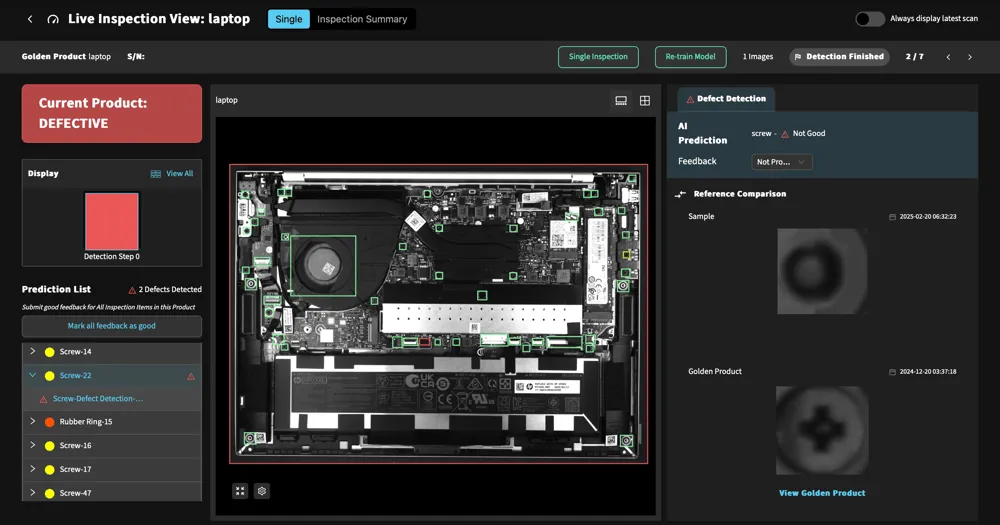
Illustration: Detection of an Incorrect Screw Installed
Step 5: Feedback and Optimization
The DaoAI AOI system features a unique feedback loop mechanism that allows real-time optimization based on detection results. In rare cases of overkill or missed detection, users can manually mark the selected area/component as correct.
As shown in the illustration, if overkill occurs, simply mark the designated area as Good (a one-click option is available on the left to mark all selected areas as Good). Conversely, if a missed detection occurs, mark the corresponding laptop component as NG, then use the tool to highlight the erroneous area (such as component damage or assembly errors). Once completed, click to retrain the model. We recommend repeating this review process multiple times in special cases to maximize performance improvements.
Just as humans learn from mistakes, the DaoAI AOI system seamlessly integrates human feedback and rapidly retrains the model, enabling real-time continuous updates. This mechanism ensures that system accuracy improves over time.
The DaoAI AOI system brings a groundbreaking upgrade to laptop assembly inspection through fully positive sample learning, pixel-level detection, and a unique feedback loop mechanism:
Please feel free to call and communicate with our technical team to experience the actual testing performance of AOI.
We will provide you with intelligent inspection reports, and DaoAI will revolutionize notebook assembly inspection for you.
Notebook assembly inspections encounter several challenges:
Component Diversity and Complexity: Notebooks comprise numerous components like motherboards, CPUs, hard drives, screens, and keyboards, each with specific assembly requirements. Variations in designs across different models further complicate inspections.
High-Speed Production and Real-Time Inspection: Modern production lines operate at high speeds, making it difficult for traditional inspection methods to keep pace, potentially allowing defects to go unnoticed.
Dynamic Production Environment: Frequent model changes and environmental factors like temperature fluctuations and unstable lighting can affect inspection accuracy.
Detection of Hidden Defects: Some defects are not immediately apparent and may only surface during later stages, making early detection challenging yet crucial.
AOI systems, such as those developed by DaoAI, offer solutions to these challenges:
Pixel-Level Detection: AOI systems can precisely identify assembly conditions of various components, ensuring adherence to assembly standards.
High-Speed Analysis: Capable of rapid inspections, AOI systems can keep up with fast-paced production lines, providing real-time defect detection.
Adaptability: AOI systems can adjust to changes in production environments, maintaining inspection accuracy despite variations in models or environmental conditions.
Efficient Use of Sample Data: By training on defect-free samples, AOI systems can detect anomalies without requiring extensive datasets of defective samples.
DaoAI's AOI system provides several features tailored for notebook assembly:
Artificial Background Blurring: Enhances focus on critical areas by reducing background noise in images.
Dynamic Feedback and Self-Optimization: Continuously improves model performance through feedback mechanisms.
Rapid Model Switching: Allows quick adaptation to different notebook models, facilitating seamless transitions in dynamic production lines.DaoAI
By employing high-resolution imaging and advanced algorithms, AOI systems can detect subtle anomalies that might be missed by manual inspections. This early detection helps in addressing issues before products reach the market, reducing the risk of recalls and maintaining brand reputation.
Yes, AOI systems are designed to be adaptable. They can be trained to recognize and inspect different notebook models, accommodating variations in design and assembly processes. This flexibility ensures consistent inspection quality across diverse product lines.
Integrating AOI into notebook assembly lines offers numerous advantages:
Enhanced Inspection Accuracy: Reduces the likelihood of defects reaching the consumer.
Increased Production Efficiency: Automated inspections speed up the quality control process.
Cost Savings: Early detection of defects minimizes rework and warranty claims.
Improved Product Quality: Consistent inspections ensure high-quality products, enhancing customer satisfaction.
From defect detection to quality control — discover what DaoAI can do for your production line.
In the modern chemical industry, crystal inspection has a crucial impact on the quality and performance of products. ...
April 09, 2025
In the past year, manufacturers have eagerly embraced vision AI in their production lines—whether in industrial ...
April 09, 2025
Using AOI (Automated Optical Inspection) to check wafer surface condition and detect metallic residue or scratches is ...
August 26, 2025
AI inspection insights, product news, and industry analysis. Once a month, no noise.