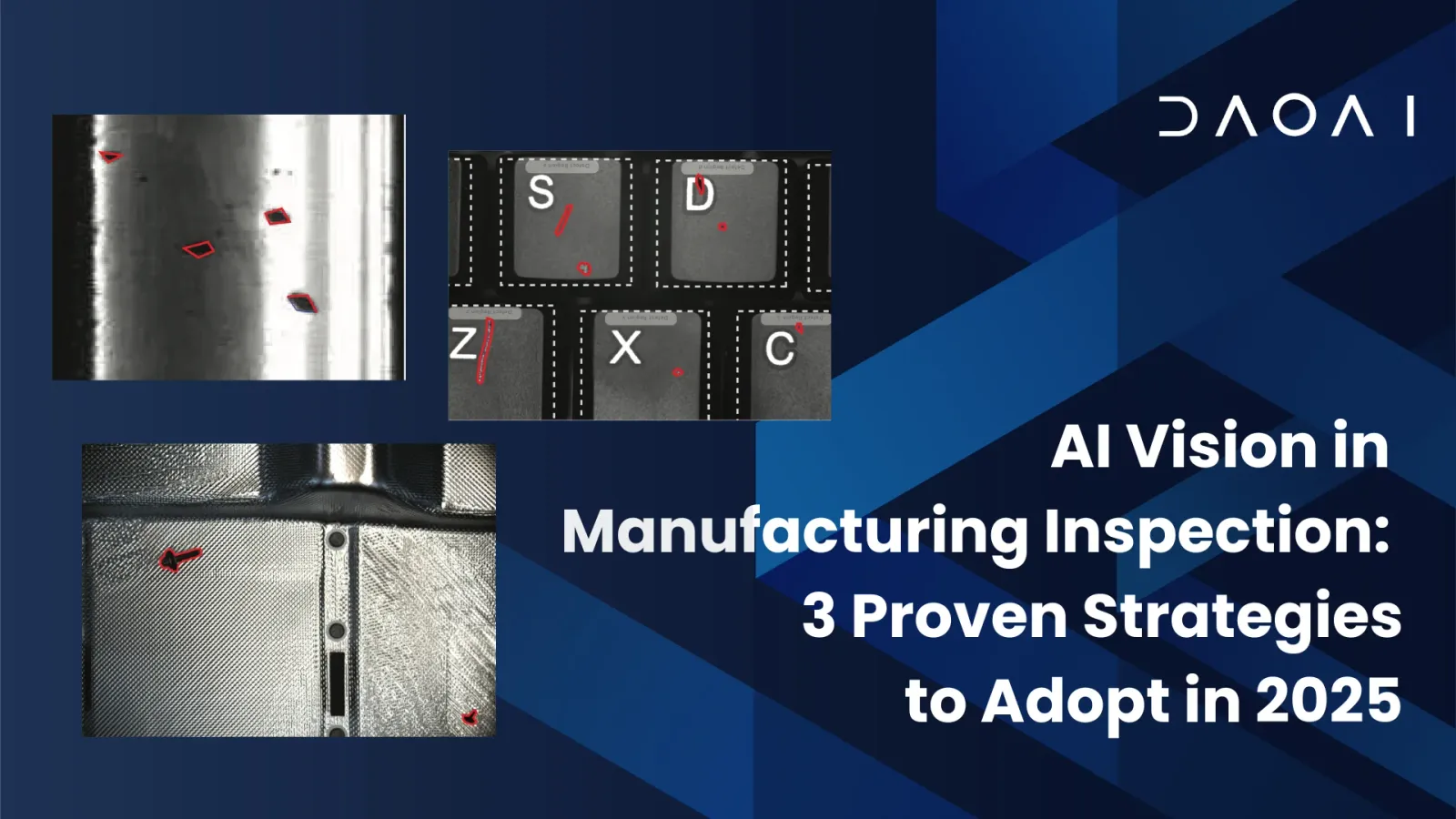
Al Vision in Manufacturing Inspection: 3 Proven Strategies to Adopt in 2025
In the past year, manufacturers have eagerly embraced vision AI in their production lines—whether in industrial ...
April 09, 2025
Edge AI — the convergence of edge computing and on-device machine learning—is revolutionizing the way artificial ...
Edge AI — the convergence of edge computing and on-device machine learning—is revolutionizing the way artificial intelligence operates. By shifting AI processing from the cloud to edge devices, businesses can deploy visual AI solutions anywhere, unlocking new possibilities for scalable applications.
Meanwhile, breakthroughs in computational efficiency, reduced hardware costs, and cutting-edge technologies are making computer vision more affordable than ever. As a result, a growing number of applications are becoming both technically and economically viable, accelerating adoption across industries.
Computer vision is not merely about seeing—it’s about understanding. These systems deliver rapid, objective, and continuous analysis that surpasses human capabilities in tasks like product inspection, defect detection, and facial recognition. By harnessing state-of-the-art deep learning models, visual AI is redefining accuracy and efficiency in industries ranging from manufacturing to healthcare.
Visual AI operates through three fundamental stages:
Transformative Use Cases Across Industries
Integrated End-to-End Solutions
The DaoAI World AI Training Platform consolidates every critical stage—from data annotation and model training to testing, deployment, and post-launch maintenance—eliminating the complexity and high costs of managing multiple standalone tools. This end-to-end solution enables businesses to complete all tasks on a single platform, significantly enhancing efficiency and reducing development time.
Advanced Technology and Flexible Scalability
DaoAI’s AOI system can rapidly build an AI model from just one defect-free sample image. With a unique feedback mechanism that continuously learns from human input, the system optimizes detection performance over time. Equipped with high-resolution cameras designed specifically for inspection, it captures minute structural details and features, detecting even the smallest flaws with precision. Seamlessly integrated with automated production line control systems—such as Siemens’ Workflow Canvas—the DaoAI AOI system ensures coordinated operation between assembly and inspection, further boosting production efficiency. In high-speed production environments, the system effectively links detection with review and repair workflows, helping businesses unlock the full potential of AI-driven visual technology.
Global industry leaders are leveraging DaoAI’s visual platform for one-stop development and operation of visual AI solutions—from data acquisition, annotation, and preprocessing, to AI model training, application deployment, and continuous monitoring. Powered by advanced AI algorithms, DaoAI enables enterprises to rapidly build scalable edge-computing vision systems that drive digital transformation and enhance market competitiveness.
Contact us today to start your digital transformation journey and unlock the full potential of Visual AI!
Visual AI is a branch of artificial intelligence that enables machines to interpret and understand visual data, such as images and videos, in a manner similar to human vision. Unlike traditional image processing, which relies on predefined algorithms to analyze visual inputs, Visual AI utilizes machine learning and deep learning models to learn from data, allowing for more adaptive and accurate interpretations.
In 2025, Visual AI is being applied across various industries:
Manufacturing: Automated Optical Inspection (AOI) systems detect defects with high precision, improving quality control.
Healthcare: AI-powered systems monitor patient safety, including fall detection and compliance with safety protocols.
Security: Enhanced surveillance through intelligent perimeter monitoring and facial recognition.
Agriculture: Automated monitoring of livestock and early detection of anomalies to ensure animal welfare.
These applications demonstrate Visual AI's versatility in enhancing efficiency and safety across sectors.
Edge AI refers to the deployment of AI algorithms on devices close to the data source, such as cameras or sensors, rather than relying on centralized cloud servers. This approach offers several benefits:
Reduced Latency: Processing data locally minimizes delays, enabling real-time responses.
Bandwidth Efficiency: Less data needs to be transmitted to the cloud, saving network resources.
Enhanced Privacy: Sensitive data can be processed on-site, reducing exposure to potential breaches.
By integrating Edge AI, Visual AI systems become more responsive and secure, which is crucial for applications requiring immediate decision-making.
The development of specialized hardware accelerators is significantly enhancing Visual AI capabilities:Medium
AI Chips: High-performance, energy-efficient processors designed for AI tasks enable faster data processing.
Embedded Systems: Compact devices with integrated AI capabilities allow for deployment in various environments.
Neural Network Processors: Tailored to handle complex AI computations, improving the efficiency of Visual AI applications.
These hardware innovations are making Visual AI more accessible and practical for widespread use.Ultralytics
Visual AI enables real-time analysis of video feeds by:
Object Detection: Identifying and tracking objects within a video stream.
Anomaly Detection: Recognizing unusual patterns or behaviors that may indicate issues.
Process Optimization: Monitoring workflows to identify inefficiencies or safety hazards.
These capabilities are transforming industries by providing immediate insights and enabling proactive responses.
Integrating Visual AI into current operations offers several advantages:
Improved Accuracy: AI models can detect subtle defects or anomalies that might be missed by human inspection.
Increased Efficiency: Automated analysis reduces the time and resources required for monitoring and quality control.
Scalability: AI systems can be scaled to handle large volumes of data across multiple sites.
Data-Driven Insights: Continuous data collection and analysis provide valuable information for decision-making.
These benefits contribute to enhanced productivity and competitiveness in various industries.
See how DaoAI's AI-powered AOI cuts false rejects, slashes programming time, and pays for itself.
In the past year, manufacturers have eagerly embraced vision AI in their production lines—whether in industrial ...
April 09, 2025
Global Stage for Smart Manufacturing Innovation This year, the DaoAI team attended Hannover Messe 2025 in Germany, ...
April 16, 2025
As a member of the Canadian Technology Accelerators program(CTA), DaoAI is honored to join with other outstanding ...
April 08, 2025
AI inspection insights, product news, and industry analysis. Once a month, no noise.